

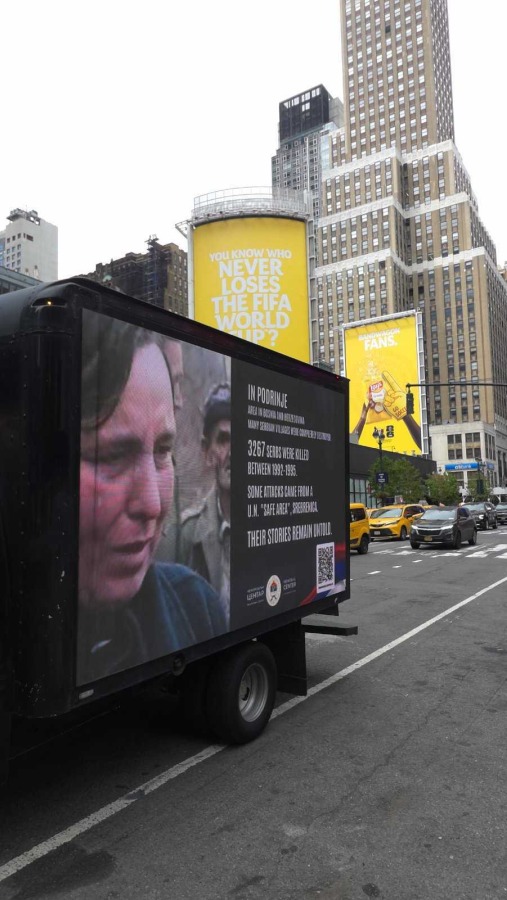
For the Serbian diaspora around the world, the news from Manhattan holds special significance — during the weekend of 10 and 11 July, the story of the centuries-old suffering of the Serbian people was brought to the streets of one of the busiest cities on the planet for the first time. The Memorial Center of the Republic of Srpska presented the international public with the campaign Learn About Serbian Suffering, which included a mobile multimedia exhibition documenting the facts about the long and difficult history of the Serbian people.
On both days, the exhibition traveled through the streets of Manhattan, whose daily population — including residents, employees, tourists and visitors — reaches almost four million people. It stopped at symbolic locations, including the space in front of the United Nations headquarters, as well as many other places that symbolize global diplomacy, media and contemporary urban life. Digital screens showed passers-by archival materials, photographs and historical facts, while a QR code directed them further to the Memorial Center’s website, specially prepared for an international audience.
The campaign starts from a question that is particularly close to everyone in the diaspora, who explain on a daily basis where they come from and who they are – the world knows Nikola Tesla, Mihajlo Pupin, Milutin Milanković, Novak Đoković and Nikola Jokić – but does it also know enough about the suffering of their people? The overall campaign message is built precisely on this contrast between the world fame of Serbian names and insufficient knowledge of the Serbian tragedy.
Exhibition visitors had the opportunity to learn about the documented facts of the genocide against Serbs in the Independent State of Croatia (1941–1945), the suffering of more than a million Serbs during World War II, and the system of concentration camps – with a reminder that the ISC was the only state in occupied Europe that established special concentration camps intended for children. The facts were also presented about the suffering of more than 30,000 Serbs during the war in Bosnia and Herzegovina, the tragedy of Serbs in the Central Drina and Birač regions, the expulsion of over 250,000 Serbs from Croatia, the suffering of Serbs in Kosovo and Metohija, camps, mass graves, missing persons, the participation of foreign mujahedin in the war in BiH, as well as the 1999 NATO bombing of the Federal Republic of Yugoslavia. A special campaign segment is dedicated to the suffering of Serbian children, aiming to show the human dimension of the tragedies marking the Serbian people through the fates of the youngest – a topic that is always close to the hearts of all those engaged in preserving the memory of Serbian victims.
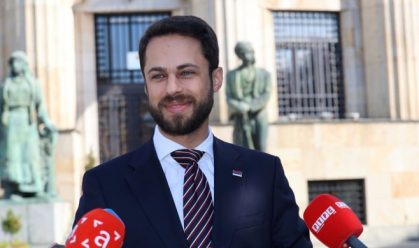
The Director of the Republic of Srpska Memorial Center, Denis Bojić, says that this campaign is the most significant international step forward for the institution since its establishment. ‘The world knows the great names of the Serbian people and their contribution to science, culture and sports. We aim to present to the international public the lesser-known part of our history – the suffering of the Serbian people. We have come to give voice to Serbian victims through documented facts, historical sources and testimonies. We believe that every victim, regardless of nationality, deserves truth, dignity and remembrance,’ said Bojić. ‘With the support of the institutions of the Republic of Srpska and the Serbian diaspora around the world, we will continue to develop this initiative and present it in other world centers,’ stated Denis Bojić, thanking the Government of the Republic of Srpska, the Ministry of European Integration and International Cooperation of the Republic of Srpska, the Representative Office of the Republic of Srpska in the United States, representatives of the Serbian diaspora, as well as Aleksandar Saša Jovičić, who offered significant support for the implementation of this international campaign.
Source: Rasejanje.info
Photo: Memorial Center of the Republic of Srpska

 EN
EN  SR
SR  DE
DE