

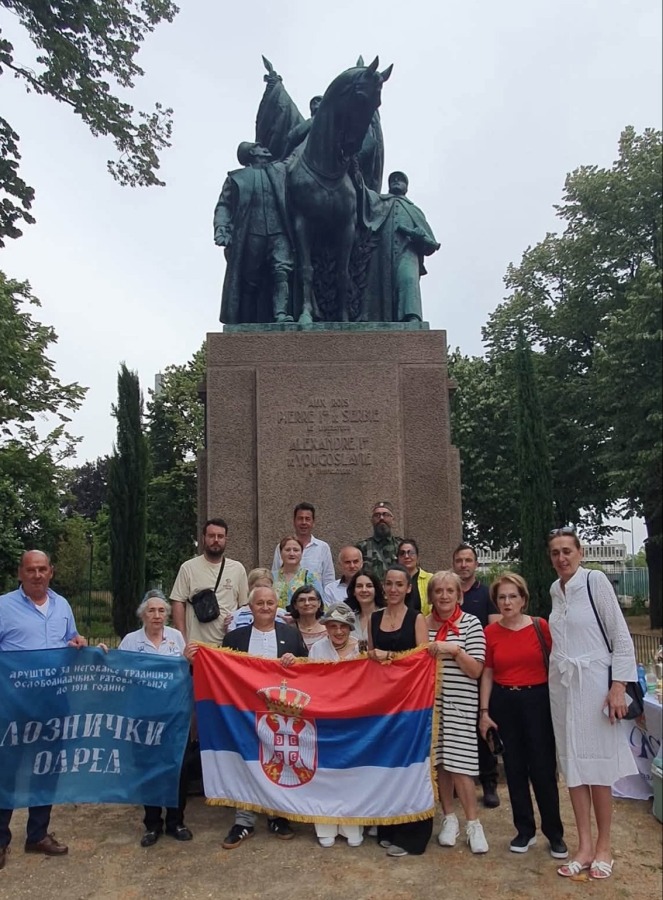
Members of the Society for the Preservation of Traditions of the Liberation Wars of Serbia until 1918 from Serbia marked Serbian Day in Paris this year, at the very place where Serbian history meets French memory most quietly, but most impressively – at the monument to Kings Peter I Karađorđević and Alexander I in the Bois de Boulogne and among the white crosses of the Serbian Military Cemetery in Thiais. With this gathering, the Society reminded us once again that Serbian Day was not just a commemoration, but a living memory of the time when a great European state had decided to tell its people the story of Serbia.
Together with the Society members, Serbian Day in Paris was also marked by a part of the Serbian community in France, whose presence, prayer and gathering, shows that the memory of Serbian soldiers and the historical friendship between the two countries lives on beyond the borders of Serbia. After more than a century, the gathering at the monument to Kings Peter and Alexander and at the Thiais Serbian Military Cemetery not only means that honor is paid to those who laid down their lives for freedom, but also preserves the memory and friendship that has survived through time – a friendship not born out of interests, but out of a common struggle, mutual respect and the willingness to lend a hand to a friend in the most difficult moments.
Marking this day on Vidovdan is no coincidence. Vidovdan is a symbol of historical memory, a day when we remember all those who laid down their lives for the freedom and dignity of the homeland. By celebrating Serbian Day in Paris on Vidovdan, the Society for the Preservation of Traditions of the Liberation Wars of Serbia until 1918, together with the Serbian community in France, merged two important memories – sacrifice and solidarity, Serbian Golgotha and French understanding. This sent a clear message that the duty to remember that friendship, built in the most difficult times, is very important, because by preserving it, it is passed on to future generations, that it is part of our identity, not a footnote in history.
Source and photo: Rasejanje.info

 EN
EN  SR
SR  DE
DE