

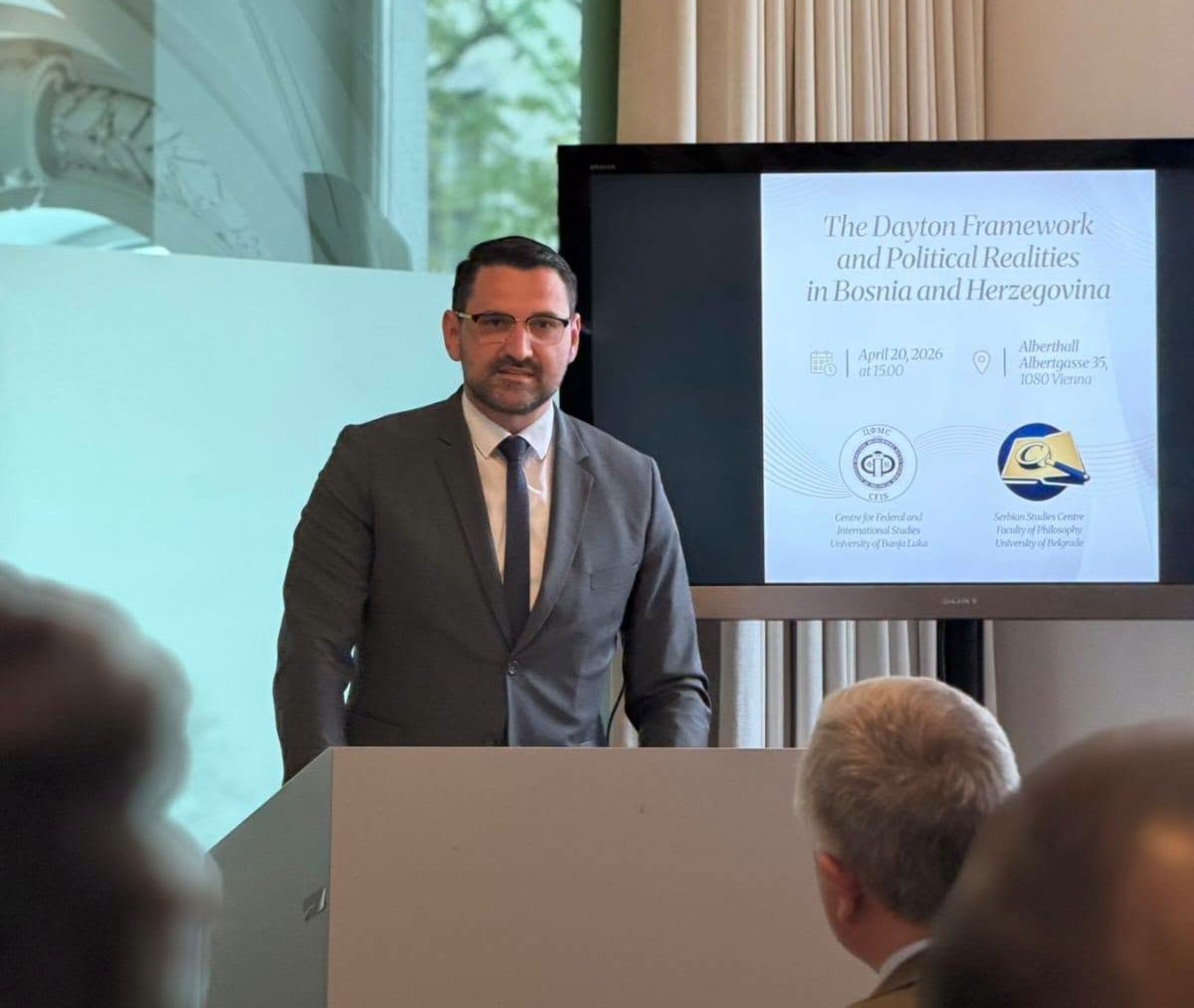
A scientific panel discussion entitled The Dayton Framework and Political Realities in Bosnia and Herzegovina was held in Vienna yesterday, dedicated to the analysis of the social and political development of BiH three decades after the signing of the Dayton Peace Agreement. The event was organized by the Center for Federal and International Studies of the Faculty of Political Science, University of Banja Luka, and the Center for Serbian Studies of the Faculty of Philosophy, University of Belgrade, with the support of the Representative Office of the Republic of Srpska in Austria.
At the beginning of the gathering, the attendees were addressed by the Head of the Republic of Srpska Representation in Austria, Mladen Filipović, who also moderated the event, after which introductory speeches were given by Zlatan Klokić, Minister of European Integration and International Cooperation of the Republic of Srpska, and H.E. Siniša Bencun, BiH Ambassador to Austria.
The program continued with a lecture by Michael Geistlinger, PhD, an expert in international and constitutional law from the University of Salzburg, who spoke about the legal and political aspects of the Dayton framework in the context of contemporary international law. Particular attention was drawn to the presentation by Prof. Geistlinger, who, during his presentation on the Office of the High Representative, referred to the fact that until 2021 all high representatives had been welcomed, supported or agreed upon by the UN Security Council, which was not the case currently.
The central part of the event was a panel discussion attended by Čedomir Antić, PhD, full professor at the Faculty of Philosophy, University of Belgrade, H.E. Aleksandar Vranješ, BiH Ambassador to Serbia and Assistant Professor at the Faculty of Political Science, University of Banja Luka, and Nina Sajić, PhD, Associate Professor at the Faculty of Political Science, University of Banja Luka.
The discussion focused not only on the institutional legacy of Dayton, but also on the broader political realities that have shaped BiH over the past three decades. The discussion included messages about the importance of returning to the original spirit of Dayton, strengthening internal dialogue and the need for greater accountability of domestic institutions. It was concluded that the stability and future of BiH depended on internal consensus, mutual respect and constructive dialogue.
Source: Ministry of European Integration and International Cooperation – Republic of Srpska Representative Office in Austria
Photo: Ministry of European Integration and International Cooperation

 EN
EN  SR
SR  DE
DE